
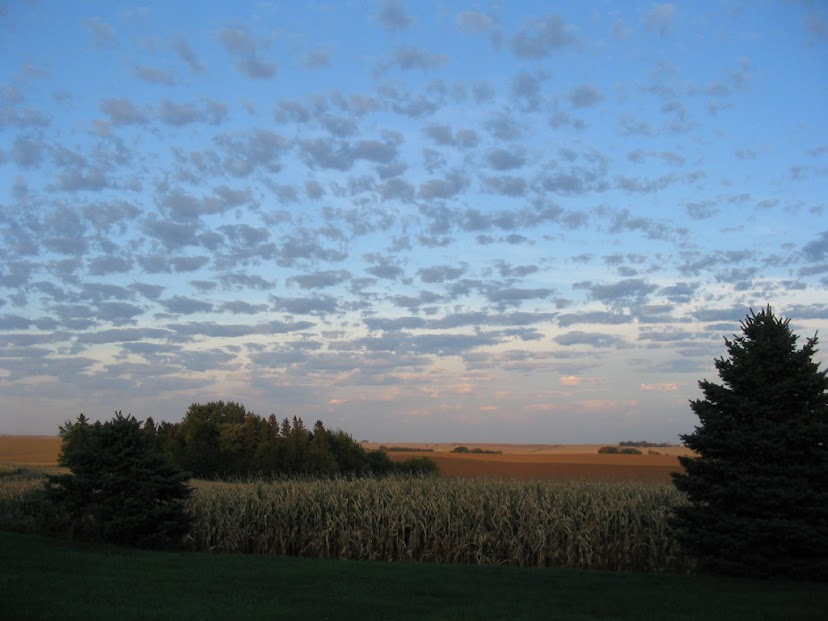
Finding the beauty in Siouxland with a point & shoot. All photos straight from the camera, a Canon PowerShot el cheapo.
Showing posts with label IA. Show all posts
Showing posts with label IA. Show all posts
Wednesday, September 7, 2011

Friday, January 21, 2011
Farmer Boy, Tiger Mothers, and me
Of all the Laura Ingalls Wilder books, Farmer Boy was my favorite as a kid. I know now that much of the appeal of Farmer Boy was how closely it mirrored my own Montessori education in important ways.
I can't briefly sketch the whole philosophy! But for our purposes: Montessori education intentionally honors a child's natural curiosity, initiative, and desire for competence. Students are responsible for their own learning, and allowed to pursue their own interests and manage their time, at a very early age. It's important for a child to develop the ability to evaluate their own work. Montessori directors (teachers) won't praise a child, because it's considered demeaning to the child if they come to work for others' praise; or in more recent pop psychobabble, their natural internal rewards must not be replaced by social or external rewards. More controversially, students are seldom required to do a project individually or in group work; it's a choice they negotiate with other students. The goal is to become competent in their own environment, by exploration, instruction, and real responsibilities.
So Farmer Boy appealed to me very much: Almanzo's a child with real responsibilities, becoming competent in his environment, well on his way to acquiring the skills he needs as an adult. His interest in horses is respected by his father. Almanzo is learning the skills and the virtues when he's 8 yrs. old that will make him an independent adult. Very Montessori.
Which brings me to the current controversy surrounding "Battle Hymn of the Tiger Mother." No, I haven't read it, but it's hard to avoid the interviews, summaries, and the backlash online. And I've known several people who were raised that way, Eastern European and Japanese. Several were young professional musicians having international careers; one was a roommate we had a suicide watch for because she was failing a class. This doesn't make me an expert by any means, but I've seen extreme positive and negative results of Tiger Mothering up close and personal.
And I admire one thing about Tiger Mothering: at least the things the child makes steep sacrifices for are things of lasting value. Diligent study habits have long term positive benefits. Playing piano or violin well is a lifetime skill--and the grown child can make that as social or private, festive or meditative, as they choose. It might not justify the rigor of this form of child rearing -that's certainly debatable- but I admire that the goals are not trivial nor transient. The musicians I've known who were forced to practice for hours from the time they were 3 (and sometimes beaten for failure) have international careers, are extraordinary musicians, and did not resent or regret the cost of their proficiency.
What upsets me a lot more is the pseudo-Chinese Mothers. They are the mothers who are shocked and puzzled that I didn't automatically put my 4 yr. old in soccer. Then when I tell them he wasn't interested, they are shocked and puzzled I didn't sign him up anyway. I've had mothers tell me point blank I am wrong not to force him into soccer (and sometimes other sports as well), and that respecting his wishes is no way to raise him. And to be clear, this is soccer 10+ hrs. a week for 4 yr. olds; they're "behind" and need remedial tutoring if they start at age 6. To me, this is worse than "Battle Hymn", because these kids make most of the same sacrifices but gain something trivial. They work harder than Almanzo did at harvest, and gain no skills that make them adults or competent in any meaningful way.
When women have told me I'm crazy not to force my kids into the sports mania and it's inevitable (yes, women have told me this to my face), I don't whack them with Montessori's theory. I tell them, as politely and gently as I can, that leadership and service are central to my family, and to develop my son's initiative and judgement I have to honor them first. That's usually the end of the conversation.
I can't briefly sketch the whole philosophy! But for our purposes: Montessori education intentionally honors a child's natural curiosity, initiative, and desire for competence. Students are responsible for their own learning, and allowed to pursue their own interests and manage their time, at a very early age. It's important for a child to develop the ability to evaluate their own work. Montessori directors (teachers) won't praise a child, because it's considered demeaning to the child if they come to work for others' praise; or in more recent pop psychobabble, their natural internal rewards must not be replaced by social or external rewards. More controversially, students are seldom required to do a project individually or in group work; it's a choice they negotiate with other students. The goal is to become competent in their own environment, by exploration, instruction, and real responsibilities.
So Farmer Boy appealed to me very much: Almanzo's a child with real responsibilities, becoming competent in his environment, well on his way to acquiring the skills he needs as an adult. His interest in horses is respected by his father. Almanzo is learning the skills and the virtues when he's 8 yrs. old that will make him an independent adult. Very Montessori.
Which brings me to the current controversy surrounding "Battle Hymn of the Tiger Mother." No, I haven't read it, but it's hard to avoid the interviews, summaries, and the backlash online. And I've known several people who were raised that way, Eastern European and Japanese. Several were young professional musicians having international careers; one was a roommate we had a suicide watch for because she was failing a class. This doesn't make me an expert by any means, but I've seen extreme positive and negative results of Tiger Mothering up close and personal.
And I admire one thing about Tiger Mothering: at least the things the child makes steep sacrifices for are things of lasting value. Diligent study habits have long term positive benefits. Playing piano or violin well is a lifetime skill--and the grown child can make that as social or private, festive or meditative, as they choose. It might not justify the rigor of this form of child rearing -that's certainly debatable- but I admire that the goals are not trivial nor transient. The musicians I've known who were forced to practice for hours from the time they were 3 (and sometimes beaten for failure) have international careers, are extraordinary musicians, and did not resent or regret the cost of their proficiency.
What upsets me a lot more is the pseudo-Chinese Mothers. They are the mothers who are shocked and puzzled that I didn't automatically put my 4 yr. old in soccer. Then when I tell them he wasn't interested, they are shocked and puzzled I didn't sign him up anyway. I've had mothers tell me point blank I am wrong not to force him into soccer (and sometimes other sports as well), and that respecting his wishes is no way to raise him. And to be clear, this is soccer 10+ hrs. a week for 4 yr. olds; they're "behind" and need remedial tutoring if they start at age 6. To me, this is worse than "Battle Hymn", because these kids make most of the same sacrifices but gain something trivial. They work harder than Almanzo did at harvest, and gain no skills that make them adults or competent in any meaningful way.
When women have told me I'm crazy not to force my kids into the sports mania and it's inevitable (yes, women have told me this to my face), I don't whack them with Montessori's theory. I tell them, as politely and gently as I can, that leadership and service are central to my family, and to develop my son's initiative and judgement I have to honor them first. That's usually the end of the conversation.
Tuesday, January 18, 2011


Monday, January 17, 2011

Sunday, January 16, 2011


Saturday, January 15, 2011

Tuesday, January 4, 2011
shopping

Given my choice of buying a pair of jeans or going to the dentist, I'd always choose the dentist. Any novel where a woman's shoe-buying hobby is considered character development is not worth reading further. One summer, by a series of unlikely circumstances, I ended up selling women's clothes in a nice department store and it was Kafka vs. Nietzsche. I watched a lot of "Xena the Warrior Princess" that summer, let me tell you.
So I hardly ever shop other than pillaging grocers. If sizes actually were standardized, I'd probably buy everything online. The next best thing is Goodwill stores. I still try to go only a couple of times a year, but the odd treasure outweighs the existential anguish.
I'm going to a wedding soon and this prompted a trip yesterday. I distracted myself from the clothes by scoping the household stuff. I resisted the very nice white gravy boat for $3. I'm the last cook in America who denies the microwave, so I could have justified the $1 doubleboiler for melting chocolate. But do I need to melt more chocolate? No.
But my husband found the duck picture and bought it for me. A label on the back, undated, explains that it's an imitation of a 19th cent. style, printed and then watercolored. I was nonplussed at first--what duck looks like that?? It's like a mallard in the worst pit of Van Gogh's yellow period.
But I searched the Internet for the duck, whose genus and species is part of the print. Lo and behold, that's a real duck in Australia! The Australian Shelduck. And the picture is quite a good likeness. The Internet being what it is, I readily found videos, zoo info. on its life cycle, its original classification in 1828, and a company that will sell me a live pair for $650.
Sorry the photo isn't better. To get a good picture, I'd need to remove it from the frame, which is going to be a significant operation and I don't yet have the frame that will be its new home. It's the first piece of art I've bought since moving here in '06.
Saturday, January 1, 2011
Wilder Wolves 2
Continued from yesterday's post on the Little House Books.
Did she fictionalize some of it? Did Pa fictionalize some of this to her, which is passed on as she heard it? The account of the Indian in the store predicting a terrible winter (ch.7), which she could have heard from both Pa and Almanzo, is really suspicious. The stilted English and inscrutable, nature-savvy Indian were familiar stereotypes at the time these were published. The skilled White hunter/trapper who understands the Indian dialect and sign language was familiar, too.
The wolf story (ch. 7) in Little House on the Prairie raises the same suspicion. Wolf stories are very popular in the late 19th and early 20th centuries. And if I were to reread the whole series, I expect I'd find at least one big example of an incident like the Indian prediction or the ride with the wolves that directly met reader expectations. The West was already heavily mythologized when she started publishing these, the family needed the money, and Rose knew a lot about marketing. Means, motive, and opportunity.
What gets left out? A great deal! Not just practical things like how they used the bathroom while snowed in or how all those animals got made into meat throughout these books. It makes sense that this would be left out in the 1930's and 1940's, because even most juvenile readers would already know.
But let's take the end of The Long Winter. We hear that no one got lost in a storm, and the family made it through. But we don't hear that everyone in town made it through; it implies that no one developed rickets or lost their minds, or that no one got drunk and beat his wife. These stories presage John Wayne's West (without a sheriff), not Clint Eastwood's.
And reading Iowa history raises a lot more questions. We hear of Ma's contempt for foreign women, but we don't meet them. How often did Ma assist at a birth or wash the dead for burial, and when did she start taking Laura along? Where's the whiskey? Where are the Catholics?
What would have happened to them had Pa died in one of the many instances he risked his life? Iowa had several orphanages, secular and religious, and the mothers were alive for a lot of those kids. But for a lot of this story, ending up in an orphanage would have been a best case scenario.
The books present themselves as an ordinary autobiographical "contract" of truthful exposition by the author as Derrida excruciatingly outlines. They arguably have a deliberate political and cultural agenda, as my African teacher would point out. And the narrator alternately conceals facts and interprets others for effect as Wolfe taught me to notice.
I'm not trying to ruin anyone's reading! But there's literary artifice and cultural agenda here beyond the necessary limit of one person's perspective. Of course, I don't lay that on my kids. I'm taking care, as my boy reads them, that he gets a wider perspective than the mythologizing going on here. That's not too hard to do while living here, and it's a good opportunity to teach him, gently, to ask questions as he reads. Most juvenile literature is far too simplistic to be a good teaching opportunity.
more soon, a different take on Farmer Boy
Did she fictionalize some of it? Did Pa fictionalize some of this to her, which is passed on as she heard it? The account of the Indian in the store predicting a terrible winter (ch.7), which she could have heard from both Pa and Almanzo, is really suspicious. The stilted English and inscrutable, nature-savvy Indian were familiar stereotypes at the time these were published. The skilled White hunter/trapper who understands the Indian dialect and sign language was familiar, too.
The wolf story (ch. 7) in Little House on the Prairie raises the same suspicion. Wolf stories are very popular in the late 19th and early 20th centuries. And if I were to reread the whole series, I expect I'd find at least one big example of an incident like the Indian prediction or the ride with the wolves that directly met reader expectations. The West was already heavily mythologized when she started publishing these, the family needed the money, and Rose knew a lot about marketing. Means, motive, and opportunity.
What gets left out? A great deal! Not just practical things like how they used the bathroom while snowed in or how all those animals got made into meat throughout these books. It makes sense that this would be left out in the 1930's and 1940's, because even most juvenile readers would already know.
But let's take the end of The Long Winter. We hear that no one got lost in a storm, and the family made it through. But we don't hear that everyone in town made it through; it implies that no one developed rickets or lost their minds, or that no one got drunk and beat his wife. These stories presage John Wayne's West (without a sheriff), not Clint Eastwood's.
And reading Iowa history raises a lot more questions. We hear of Ma's contempt for foreign women, but we don't meet them. How often did Ma assist at a birth or wash the dead for burial, and when did she start taking Laura along? Where's the whiskey? Where are the Catholics?
What would have happened to them had Pa died in one of the many instances he risked his life? Iowa had several orphanages, secular and religious, and the mothers were alive for a lot of those kids. But for a lot of this story, ending up in an orphanage would have been a best case scenario.
The books present themselves as an ordinary autobiographical "contract" of truthful exposition by the author as Derrida excruciatingly outlines. They arguably have a deliberate political and cultural agenda, as my African teacher would point out. And the narrator alternately conceals facts and interprets others for effect as Wolfe taught me to notice.
I'm not trying to ruin anyone's reading! But there's literary artifice and cultural agenda here beyond the necessary limit of one person's perspective. Of course, I don't lay that on my kids. I'm taking care, as my boy reads them, that he gets a wider perspective than the mythologizing going on here. That's not too hard to do while living here, and it's a good opportunity to teach him, gently, to ask questions as he reads. Most juvenile literature is far too simplistic to be a good teaching opportunity.
more soon, a different take on Farmer Boy
Friday, December 31, 2010
Wilder Wolves
As an undergraduate, I once got shanghaied into an advanced class on autobiography, all modern, secular and gloomy, and theory-laden. I even had to read Derrida! Aaaiiiee! But one of the few bright spots of graduate school was getting permission to take a class from one of the living authors I admired most, and he was teaching a class on Third World prison literature, which was mostly autobiography. He had also been a political prisoner himself in Kenya. The first day of class, he dismissed literary theory with a contemptuous wave of the hand as the useless piffle of privileged men who didn't actually have anything important to write about.
When I taught short fiction writing at Deep Springs, I included a section of autobiography. It went okay, but that's the part I wish I could do over. Since then, I've read Gene Wolfe, and that changed everything.
Mr. Wolfe writes first person fiction. But as he's pointed out in his interviews and essays, it's the consistent, honest narrator who explains everything clearly that's completely unrealistic. Human memory isn't like that, and it's no fun for readers if there's nothing to figure out on your own. So his narrators contradict themselves, lie, might have a mental impairment, and certainly don't explain or interpret everything. Mr. Wolfe is a genius. (And a lot of what he says applies to blogs - the good ones anyway- and a blog/book narrative like Julie and Julia.)
All this colors my reading of the Laura Ingalls Wilder books. I like them, in part because they are much better prose than usually gets foisted off on children. And they are very well constructed. Rose Wilder Lane assisted her mother in writing them (how much is debated) and she was a world traveler, market-savvy writer and journalist. Rose was also among the founders of Libertarianism.
The Wilder books have a good bit of artifice, and that makes them better reading.
The Long Winter is a good example of the artifice underlying the books. To wit:
How are the different perspectives on The Indian Question presented? What assumption do all those perspectives have in common and how does that assumption get presented and supported? That's too well done to have been an accident.
What's Laura's relationship with animals and nature? How does the narrator use nature to control the pacing, tone, and mood? How does this convey a child's perspective?
Ma and Pa are clearly foils to each other, and I think it's more than obvious gender roles. When Ma and Pa differ, what's it tell us about them as different types of settlers?
Right off, economics are much more obvious than any other juvenile books I know, but it's all shown without theory. How are businessmen and business practices presented?
In the same vein, how is government and/or centralized authority shown? How is information spread?
What's are the virtues? How are they acquired and shown? What are the consequences, and to whom, of lacking a virtue?
As soon as I start to answer these questions, it's clear how carefully constructed these stories are. They are certainly not naive productions.
more tomorrow
When I taught short fiction writing at Deep Springs, I included a section of autobiography. It went okay, but that's the part I wish I could do over. Since then, I've read Gene Wolfe, and that changed everything.
Mr. Wolfe writes first person fiction. But as he's pointed out in his interviews and essays, it's the consistent, honest narrator who explains everything clearly that's completely unrealistic. Human memory isn't like that, and it's no fun for readers if there's nothing to figure out on your own. So his narrators contradict themselves, lie, might have a mental impairment, and certainly don't explain or interpret everything. Mr. Wolfe is a genius. (And a lot of what he says applies to blogs - the good ones anyway- and a blog/book narrative like Julie and Julia.)
All this colors my reading of the Laura Ingalls Wilder books. I like them, in part because they are much better prose than usually gets foisted off on children. And they are very well constructed. Rose Wilder Lane assisted her mother in writing them (how much is debated) and she was a world traveler, market-savvy writer and journalist. Rose was also among the founders of Libertarianism.
The Wilder books have a good bit of artifice, and that makes them better reading.
The Long Winter is a good example of the artifice underlying the books. To wit:
How are the different perspectives on The Indian Question presented? What assumption do all those perspectives have in common and how does that assumption get presented and supported? That's too well done to have been an accident.
What's Laura's relationship with animals and nature? How does the narrator use nature to control the pacing, tone, and mood? How does this convey a child's perspective?
Ma and Pa are clearly foils to each other, and I think it's more than obvious gender roles. When Ma and Pa differ, what's it tell us about them as different types of settlers?
Right off, economics are much more obvious than any other juvenile books I know, but it's all shown without theory. How are businessmen and business practices presented?
In the same vein, how is government and/or centralized authority shown? How is information spread?
What's are the virtues? How are they acquired and shown? What are the consequences, and to whom, of lacking a virtue?
As soon as I start to answer these questions, it's clear how carefully constructed these stories are. They are certainly not naive productions.
more tomorrow
Wednesday, December 29, 2010
Gravy Train
 All those black tank cars are full of beef tallow and lard. Thousands of gallons of animal fat.
Tuesday, December 21, 2010
Little House on the Prairie (Not)


Right now I'm reading 2 books on early Iowa history. It seemed timely to reread Laura Ingalls Wilder's Little House on the Prairie as a break from the less-than-luminous prose of professional historians and anthropologists. The whole set comes through the house at least once a year and probably deserves a post of their own, 'though it might tell you more about me (and maybe Deep Springs indirectly) than Iowa: I thought the Indians coming in the house wearing fresh skunk skins and eating everything was actually really funny--surely the Indians did that on purpose, and probably on a bet.
But all this pioneering narrative makes me remember coming to Iowa myself, and exactly the sort of topic Mrs. Wilder never mentioned. That's right, the outhouse.
In the late summer of '06 I moved into rural Iowa. How rural? The photo on my header was the view over the kitchen sink.
My husband commuted and I was home with little kids. There was corn and soybeans as far as the eye could see; most farms are more than a thousand acres, so farmhouses were few. There were two hog operations just out of sight.
Now, I'm not really country, but I've lived in the country enough to be concerned about moving into a house that hadn't been lived in for a few years. But we were assured by the landlord that the septic system was fine. It was built in the 1960s, a brick house with a big basement, reasonably tight for the winter. It had a few quirks--striped carpet in the kitchen, an Austin Powers carpeted bathroom--but a nice little house for us while our house in Michigan waited to sell. The pavement ended just past us. Winter came early.
And then one day I went into the basement to do laundry....But between me and the washer and dryer was a lake some 18 feet across that could only have one origin: the big drain in the middle of the basement floor. The landlord came out and located the top of the septic, which was buried under the snow, by sighting from the eaves. A man came in a tank truck and pumped the septic tank into his truck, checked with me that the basement had drained, and left. All hunky dory. Just a lot of disinfecting to do downstairs.
But a week or so later, it wasn't hunky dory. The lake was back. Further investigation by the experts revealed that the leach field was dead and would have to be dug and replaced in about six months. The ground was frozen and we were without septic until it thawed: two adults, a baby just starting to walk, a preschooler still in diapers, and our personal hygiene, laundry, cooking and dishes. So we conserved water in a major way, and every week or ten days I'd have the following phone conversation with our landlord:
Me: Hi, Bob. It's Foodie. We've got water downstairs again.
Bob: Okay, I'll call the guy. 'Bye.
Then the next day, or Monday if this unfortunately happened on Friday, two guys in overalls with a portable pump would drive around back, pump out the tank and shoot the septic water out onto the snow over the leach field.
Seven months later the ground thawed and a bobcat, backhoe, large bladed tractor, and a dump truck full of gravel arrived to dig and replace the leach field all in one day. For my 4 yr. old boy it was like Christmas! Real diggers came to our house! And that's all he remembers about the situation.
Let's review that winter: outside, the smell of two big hog farms and months of pumped out sewage water. In the house, 2 kids in diapers and super low water use. In the basement, regular sewage floods. They only saw other children (sometimes) when we drove in to the county library. But if he describes to you the 14 months we spent there, he says something like this:
We lived out in (Not on Any Map) a while. There was a big blizzard on my birthday and there was a snow drift all the way up the front door. Daddy had to dig a valley out to take the dog out. It was really windy all the time so we couldn't have picnics, but there were a whole lot of fireflies, like the stars fell down to dance around above the soybean plants. The computer was really slow and I couldn't download big Lego instructions. And then one day lots of diggers came to our house. They dug a big hole and a dump truck dumped a bunch of gravel but then they covered it up. We moved on my sister's birthday but that was okay because there wasn't anybody to invite to a party but Grandma came and we had lunch with her at a restaurant while Daddy and his Dad did the moving truck.
Monday, December 20, 2010
Learning Iowa: Butter
Yet since no actual cash passed into her hands and because she was laboring within the family unit, the frontierswoman was still not officially considered as gainfully employed. This logic extended to her production of surplus domestic goods such as butter and eggs which were sold outside the home for actual cash. Historian Gilbert Fite maintains that butter was a primary cash product on the farmer's frontier, its income often keeping farms afloat during the rocky years.
Riley, in Frontierswomen: The Iowa Experience. The research she cites to support her own is Fite, The Framers' Frontier, 1865-1900.
An anecdote she recounts involves saving large amounts of butter and selling it all at one major trip to town. This is striking because Iowa had settlement going on while there were already well-established towns in Iowa. But I haven't found any references yet to farmers on the outskirts of towns supporting themselves as market farmers. If this is the case, it might explain the lack of CSAs in Western Iowa now.
Saturday, November 27, 2010
(folk)art spotting in Siouxland 2
 Mexican plaque of Our Lady of Tepeyac (Guadalupe). Molded natural plaster, painted. Mexico City, 1980. Both Mary and the angel have blush and eyeshadow, not on the original.
Friday, November 26, 2010
(folk)art spotting in Siouxland 1

 Above: Mexican painted terracotta on a kitchen cabinet door. 2007.
Below: Mexican bas relief of Archangel Raphael, patron saint of travelers, young people seeking a spouse, and folks seeking their calling in life. Painted papier mache over carved styrofoam. 1983. Brought from Guanajuato, Mexico. The fish and staff are standard iconography, but note the inverted wings. Hung over a crib.
Friday, November 19, 2010
Former church, improved

Neighborhood kid: Are you taking pictures?
Me: Yes, just for fun.
Kid: Isn't it cool? It's got apartments in it now. I wish it were my house, 'cause it would be fun to live there.
Me: Yes, I'd like to have it, too. I'd live on one floor, make another floor a school, and make one whole floor a big rink for roller hockey.
Kid: yeah! that would be cool. (leans closer) It's supposed to be haunted.
Thursday, November 18, 2010
Ironworks

 These are all over the Siouxland area. The company began in 1871. A 1923 local business profile lists cistern collars, coal chutes, pipes and manhole covers, building columns, and boilers among their products. The large sewer lid shown above is a few feet from a sidewalk engraved 1905.
The company still exists, with locations in Sioux City and Nebraska. They're hiring.
Wednesday, November 17, 2010


Saturday, November 13, 2010
Rural Graveyard : fall & winter

 Two views taken several years ago, with my first digital camera. Some of the tombstones are older than the church; Catholic settlers relocated their family graves from their homesteads when consecrated ground became available. A number of WWI veterans are buried there, and a lot of infants and children from the early days.
Even though I wasn't really trying to capture this when I took the pictures, I like them together. The winter photo was brutally cold and dark at midday; Vitamin D deficiency (rickets) probably accounts for some of the dead. The fall photo shows the almost unbelievable fertility of the land that the settling families risked so much for. This land was tallgrass prairie before settlement, part of the 19th c. hunting ground of the Sioux.
Rural Graveyard: spring
 This graveyard is adjacent to a tiny Catholic church. Stubble stands in the fields all winter. I had thought that might have been for wind erosion--the wind is terrible--but the combines are set to the precise height needed to give shelter to pheasants.
Friday, November 12, 2010

Subscribe to:
Posts (Atom)