So, there's a food photography contest at the Pioneer Woman's site. I'm not aspiring to win, but I signed up, and am I ever glad! Because if you join the photo pool, you can see all the submissions.
A wise friend gave me a good piece of advice a couple of years ago about a peculiar community I'll be part of for the rest of my life. (yeah, peculiar communities are kinda a habit with me.) She said if you make a habit of thanking people and telling them when they do a good job, people are always glad to see you coming. So when I scoped out the photo submissions, I complimented the ones I liked. None of these folks know me from Adam's house cat, but who cares? Complimenting the photographers only takes a minute & made my viewing more pleasant.
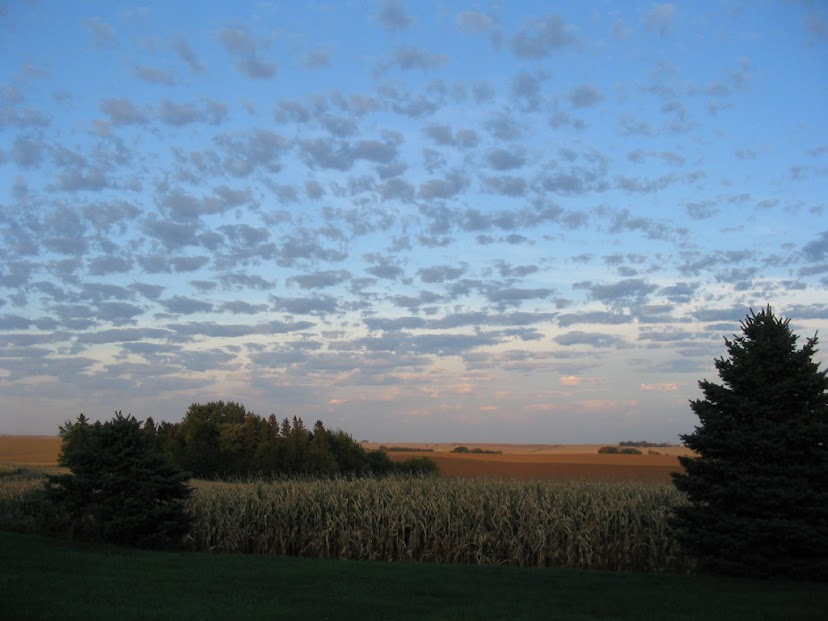
Finding the beauty in Siouxland with a point & shoot. All photos straight from the camera, a Canon PowerShot el cheapo.
Wednesday, January 12, 2011

Thursday, January 6, 2011
More Chicken Under a Brick

Lemon Artichoke Heart Soup

Olive Oil Bread

Chicken Under a Brick

Chocolate Coconut pots de creme
I really wanted the chicken to be the focus of the meal, and the menu reflected that.
The soup is Greek avgolemnos with imported artichoke hearts. Early January isn't the time for fresh produce and the artichoke went well in the lemony soup. I put thyme in mine, to echo the chicken's marinade. If you put the artichoke in early and let it sit, the flavor infuses the soup without any labor by the cook.
Olive oil bread because the table looks naked without it. And my kids gobbled it down while I cooked the chicken and our guest regaled us with tales of his very successful hunting trip, complete with large caliber rifles, large caliber handguns, trucks, and barbecue. Oh, and he's a priest. One of the things I love about Iowa is that almost all the clergy are avid hunters.
The chicken was the star, and turned out really well, as I wrote yesterday. Tomato sauce would have been overbearing with it, so...
I served this with bowtie pasta in a mild picata sauce. Picata (piquant) sauce is a versatile clear pasta sauce made with lemon juice, chicken stock, and white wine. Sauteed garlic, capers, green olives, or other little flavor bombs can be added. The cook has a lot of freedom to set the tone, and I used garlic, nonpareil (very small) capers and omitted the wine. I think small pieces of green olives would be better. White wine would have clashed with the bacon, and leaving it out was fine. It's the right taste, but doesn't make for an interesting photograph. If it's new to you, grated cheese is not ever appropriate with picata sauce.
The Belgian dark chocolate coconut pudding was a huge success. It's obviously not Italian, but it's so good no one cares. My son plaintively suggested we buy larger cans of coconut.
I know diddley about wine and seldom drink it. But for what it's worth, we decided all this tangy food needed a table wine on the sweet side and not too heavy. We drank an '09 Alice White (Australian) red lexia. I've never even heard of red lexia before. But it was good, went well with the food, and wasn't expensive. Since I like Greek food and can't get Rhoditis here, we'll certainly get it again; not too many wines play well with lemon and bacon both.
And yes, I confess to a tiny bit of food styling.
Chicken Under a Brick

I'm always a little worried when trying a new recipe I haven't been served: "how do I know if I got it right?" Since I was fortunate to eat Tom's cooking for 3 years, I felt confident making his Chicken Under a Brick from the cookbook for a guest who regularly goes to Italy. But if you're unfamiliar with the dish, have no worries when you follow his instruction. Just do what he says, and you'll nail it.
The Recipe...
is fine. Really, just do what he says. I was very happy he includes a variation for skinless, boneless chicken thighs, because that was all we could get in the all-natural chicken.
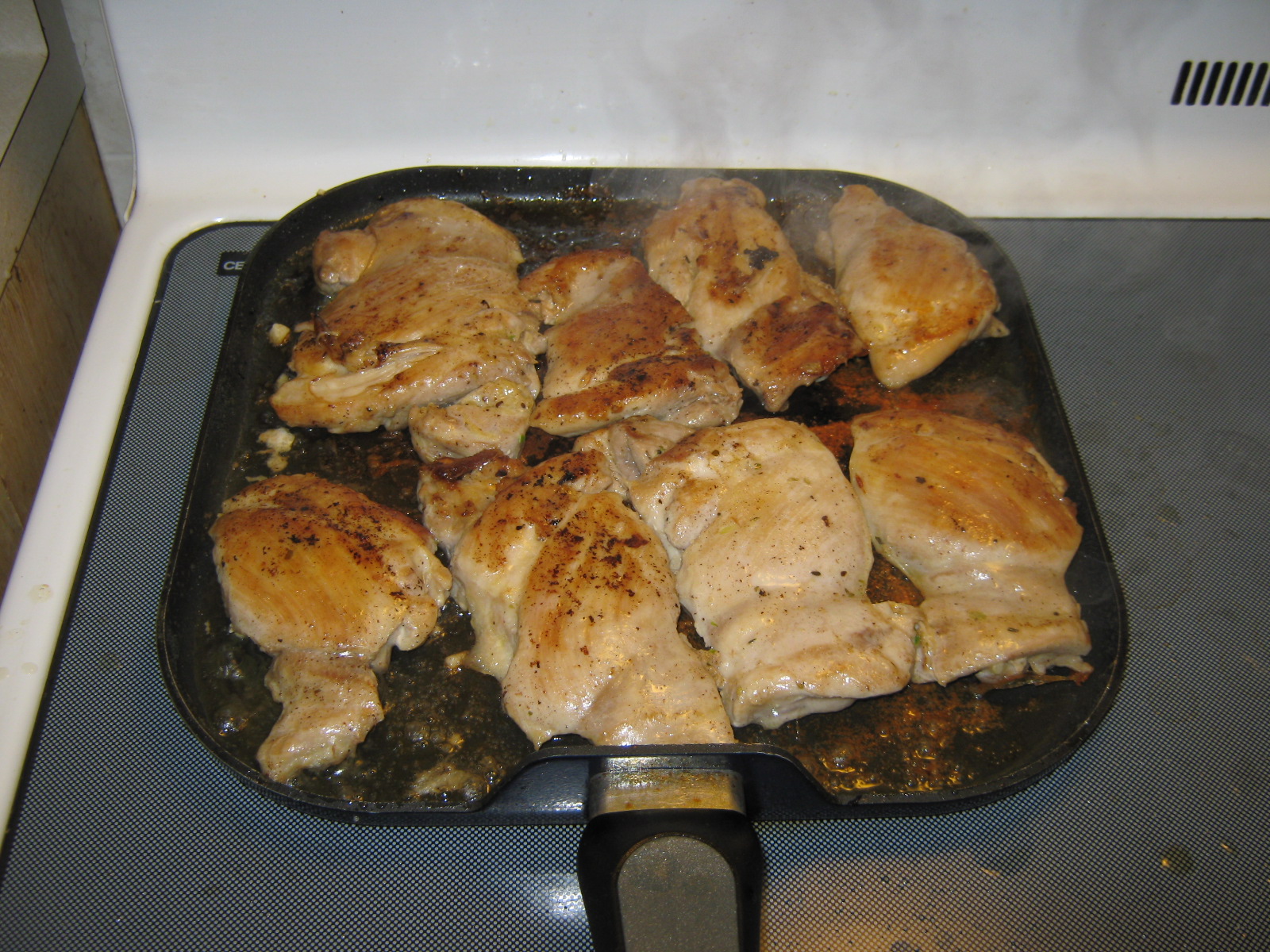
I fiddled with the recipe in two ways. I marinaded it for about 5 hours, far longer than suggested, and it wasn't overwhelmingly garlicky. In my house, time flexibility is a plus! And I didn't wrap it in bacon strips, but fried it in bacon grease & fond. It didn't crackle as it would have with bacon, but it still had a flavorful, crusty exterior.
It's pretty subtle. The meat is moist but not greasy. The bacon flavor from the hot grease doesn't penetrate, but the marinade does, so it still tastes like chicken, rather than bland hunk o' white stuff holding up bacon. I'll post the rest of the menu next.
The Method...
is classic, and I well remember Tom's collection of bricks in an out of the way corner of the Boarding House. My kitchen, alas, has no out of the way corners, being the size of a lentil. And I wanted to make a lot because leftovers make splendid spinach salad.
So, I improvised with the biggest, heaviest thing in my kitchen, a cast iron griddle that's as wide as my nonstick griddle but twice as long, so there's plenty of space for me to grab it. Serendipitous, no? It worked like a charm.


BUT, please notice I have a flat stove top, so there's no place for the grease to puddle. Since the bottom griddle didn't catch splatters, and they could just drip off the larger top griddle, a thin layer of hot grease surrounded the operation. I carefully mopped this up a couple of times and it wasn't a big deal. But if your stove isn't flat, doing what I did would be very dangerous. Use a brick or something smaller than the bottom pan. Tradition's smart on this one. If you're brickless but have nesting cast iron frying pans I think that would work well, too.
If you have a flat top stove, it's great. Be sure to use oven mitts to handle the iron griddle. It doesn't warm much itself, but the splattering grease and steam underneath could burn you. I did this twice with no trouble at all. The taste is worth it.
Wednesday, January 5, 2011
coming soon
Company's coming for dinner, so I hope to have some big posts in the next couple of days. The big story: cooking Italian Chicken Under a Brick from Tom Hudgens' new cookbook. See the link on the right!
Tuesday, January 4, 2011
shopping

Given my choice of buying a pair of jeans or going to the dentist, I'd always choose the dentist. Any novel where a woman's shoe-buying hobby is considered character development is not worth reading further. One summer, by a series of unlikely circumstances, I ended up selling women's clothes in a nice department store and it was Kafka vs. Nietzsche. I watched a lot of "Xena the Warrior Princess" that summer, let me tell you.
So I hardly ever shop other than pillaging grocers. If sizes actually were standardized, I'd probably buy everything online. The next best thing is Goodwill stores. I still try to go only a couple of times a year, but the odd treasure outweighs the existential anguish.
I'm going to a wedding soon and this prompted a trip yesterday. I distracted myself from the clothes by scoping the household stuff. I resisted the very nice white gravy boat for $3. I'm the last cook in America who denies the microwave, so I could have justified the $1 doubleboiler for melting chocolate. But do I need to melt more chocolate? No.
But my husband found the duck picture and bought it for me. A label on the back, undated, explains that it's an imitation of a 19th cent. style, printed and then watercolored. I was nonplussed at first--what duck looks like that?? It's like a mallard in the worst pit of Van Gogh's yellow period.
But I searched the Internet for the duck, whose genus and species is part of the print. Lo and behold, that's a real duck in Australia! The Australian Shelduck. And the picture is quite a good likeness. The Internet being what it is, I readily found videos, zoo info. on its life cycle, its original classification in 1828, and a company that will sell me a live pair for $650.
Sorry the photo isn't better. To get a good picture, I'd need to remove it from the frame, which is going to be a significant operation and I don't yet have the frame that will be its new home. It's the first piece of art I've bought since moving here in '06.
Sunday, January 2, 2011
atsa ragu to you


A true ragu is a big hunk of meat seared and then simmered slowly in tomato sauce (usually on a rack, so it doesn't scorch on the bottom). When the meat reaches the stage of being tender but not yet falling apart, it's fished out, sliced, and served with pasta. The meat-infused sauce is then poured by each diner from a gravy boat. It takes a long time, and you have to hover over the pot a bit to make sure the meat doesn't cook past the point it can be sliced.
For special occasions, a ragu might be made with mixed meats. If you peek in the freezer of a Sicilian cook, there's often a bag of leftovers, that one extra pork chop or a marrow bone, hoarded away for just this purpose. I've never seen sea food mixed with meats or poultry in Italian cooking, but just about everything else can go into a ragu.
For my husband, it's not a special occasion ragu without some lamb. The bad news is that lamb is expensive. The good news is that the flavor really travels--other meats pick up the flavor readily. But there's a trick to this, and it works well if your life doesn't allow you to hover over the pot all day.
The trick is to control the fat. The traveling lamb flavor is in the fat, so you don't want to give it much competition. You'll need a frying pan, a simmering pot, and a crock pot.
The hunks of meat will go in the crock pot. If you actually read the instructions (does anyone but me?) they say to carefully trim all the fat off meat going into your slow cooker. It's important! The steam at the top of the slow cooker can become very hot and give oil floating on top a very unpleasant taste. When you trim the hunk of lamb, cut the fat and bone out but save them both. Discard the fat trimmed from other meats. I find it works well to have a layer of sliced raw onions on the bottom, then the meat, then sprinkle with dried herbs, and then lightly fried garlic on top. Lid on, and let it cook.
Meanwhile, mix up a plain tomato sauce in the simmering pot. I like to use tomato paste and add liquid to the desired consistency, because it's cheaper and gives me complete control over the saltiness. Because most meat and poultry has been brined before you buy it, and canned tomatoes are very salty (even the organic ones) a ragu is easily too salty. Too much salt will ruin your palate, make your Romano cheese seems bland (if you use it), and it's not good for you.
Then make plain meatballs and fry them in a non-stick frying pan. Any ground meat will do; the meatballs in the picture are ground beef mixed with an onion grated on a cheese grater and a little oregano. The whole point is for the meat to taste like meat, so don't fuss with eggs, bread crumbs, etc. Discard the grease from the pan. For once, you're not after the fond, which won't be very good because of the grated onions anyway, because they scorch very easily.
Put the meatballs, lamb bone and fat, and one bay leaf into the tomato sauce. Simmer gently a while, then let it rest. That's the picture of the sauce, with the bay leaf and a lamb bone poking out for the photo. The meatballs (no matter what kind) will pick up a lot of the lamb flavor.
When the meat in the slow cooker is almost as tender as you'd like it to be, scoop it out and add the meat (but not the pot liquid) to the tomato sauce. Simmer a while longer, and make your pasta. If all goes well, you'll have tender meat that still has distinctly different tastes, but meatballs and sauce that taste like lamb. Discard the bay leaf and lamb bone, slice the meat, and you're ready to arrange it on a platter.
If you've eaten with an Italian family at a special occasion, you understand completely why there's no photo of the final platter.
Notes:
In the slow cooker photo I didn't sear the meat first, as with smaller pieces it doesn't make much difference. Life is short.
Doesn't it need more spice? No. This is better with a light touch on the spices: oregano and basil are shown. Some folks would put rosemary in since the lamb dominates, but I don't like rosemary with beef at all, and if you use sausage it can clash badly.
Why not just put it all in a slow cooker? You can't control the fat, and hence the flavor that way. And tomato sauce is usually ruined in a slow cooker. Again, the steam between the liquid and the lid gets very hot and it will scorch the tomato sugars at the top, giving your sauce a bitter taste. Also the bones of any baby animal such as lamb are too soft for a slow cooker anyway: it's possible for a soft bone to begin dissolving in a crock pot and that's a catastrophe.
Saturday, January 1, 2011
Wilder Wolves 2
Continued from yesterday's post on the Little House Books.
Did she fictionalize some of it? Did Pa fictionalize some of this to her, which is passed on as she heard it? The account of the Indian in the store predicting a terrible winter (ch.7), which she could have heard from both Pa and Almanzo, is really suspicious. The stilted English and inscrutable, nature-savvy Indian were familiar stereotypes at the time these were published. The skilled White hunter/trapper who understands the Indian dialect and sign language was familiar, too.
The wolf story (ch. 7) in Little House on the Prairie raises the same suspicion. Wolf stories are very popular in the late 19th and early 20th centuries. And if I were to reread the whole series, I expect I'd find at least one big example of an incident like the Indian prediction or the ride with the wolves that directly met reader expectations. The West was already heavily mythologized when she started publishing these, the family needed the money, and Rose knew a lot about marketing. Means, motive, and opportunity.
What gets left out? A great deal! Not just practical things like how they used the bathroom while snowed in or how all those animals got made into meat throughout these books. It makes sense that this would be left out in the 1930's and 1940's, because even most juvenile readers would already know.
But let's take the end of The Long Winter. We hear that no one got lost in a storm, and the family made it through. But we don't hear that everyone in town made it through; it implies that no one developed rickets or lost their minds, or that no one got drunk and beat his wife. These stories presage John Wayne's West (without a sheriff), not Clint Eastwood's.
And reading Iowa history raises a lot more questions. We hear of Ma's contempt for foreign women, but we don't meet them. How often did Ma assist at a birth or wash the dead for burial, and when did she start taking Laura along? Where's the whiskey? Where are the Catholics?
What would have happened to them had Pa died in one of the many instances he risked his life? Iowa had several orphanages, secular and religious, and the mothers were alive for a lot of those kids. But for a lot of this story, ending up in an orphanage would have been a best case scenario.
The books present themselves as an ordinary autobiographical "contract" of truthful exposition by the author as Derrida excruciatingly outlines. They arguably have a deliberate political and cultural agenda, as my African teacher would point out. And the narrator alternately conceals facts and interprets others for effect as Wolfe taught me to notice.
I'm not trying to ruin anyone's reading! But there's literary artifice and cultural agenda here beyond the necessary limit of one person's perspective. Of course, I don't lay that on my kids. I'm taking care, as my boy reads them, that he gets a wider perspective than the mythologizing going on here. That's not too hard to do while living here, and it's a good opportunity to teach him, gently, to ask questions as he reads. Most juvenile literature is far too simplistic to be a good teaching opportunity.
more soon, a different take on Farmer Boy
Did she fictionalize some of it? Did Pa fictionalize some of this to her, which is passed on as she heard it? The account of the Indian in the store predicting a terrible winter (ch.7), which she could have heard from both Pa and Almanzo, is really suspicious. The stilted English and inscrutable, nature-savvy Indian were familiar stereotypes at the time these were published. The skilled White hunter/trapper who understands the Indian dialect and sign language was familiar, too.
The wolf story (ch. 7) in Little House on the Prairie raises the same suspicion. Wolf stories are very popular in the late 19th and early 20th centuries. And if I were to reread the whole series, I expect I'd find at least one big example of an incident like the Indian prediction or the ride with the wolves that directly met reader expectations. The West was already heavily mythologized when she started publishing these, the family needed the money, and Rose knew a lot about marketing. Means, motive, and opportunity.
What gets left out? A great deal! Not just practical things like how they used the bathroom while snowed in or how all those animals got made into meat throughout these books. It makes sense that this would be left out in the 1930's and 1940's, because even most juvenile readers would already know.
But let's take the end of The Long Winter. We hear that no one got lost in a storm, and the family made it through. But we don't hear that everyone in town made it through; it implies that no one developed rickets or lost their minds, or that no one got drunk and beat his wife. These stories presage John Wayne's West (without a sheriff), not Clint Eastwood's.
And reading Iowa history raises a lot more questions. We hear of Ma's contempt for foreign women, but we don't meet them. How often did Ma assist at a birth or wash the dead for burial, and when did she start taking Laura along? Where's the whiskey? Where are the Catholics?
What would have happened to them had Pa died in one of the many instances he risked his life? Iowa had several orphanages, secular and religious, and the mothers were alive for a lot of those kids. But for a lot of this story, ending up in an orphanage would have been a best case scenario.
The books present themselves as an ordinary autobiographical "contract" of truthful exposition by the author as Derrida excruciatingly outlines. They arguably have a deliberate political and cultural agenda, as my African teacher would point out. And the narrator alternately conceals facts and interprets others for effect as Wolfe taught me to notice.
I'm not trying to ruin anyone's reading! But there's literary artifice and cultural agenda here beyond the necessary limit of one person's perspective. Of course, I don't lay that on my kids. I'm taking care, as my boy reads them, that he gets a wider perspective than the mythologizing going on here. That's not too hard to do while living here, and it's a good opportunity to teach him, gently, to ask questions as he reads. Most juvenile literature is far too simplistic to be a good teaching opportunity.
more soon, a different take on Farmer Boy
Subscribe to:
Posts (Atom)